
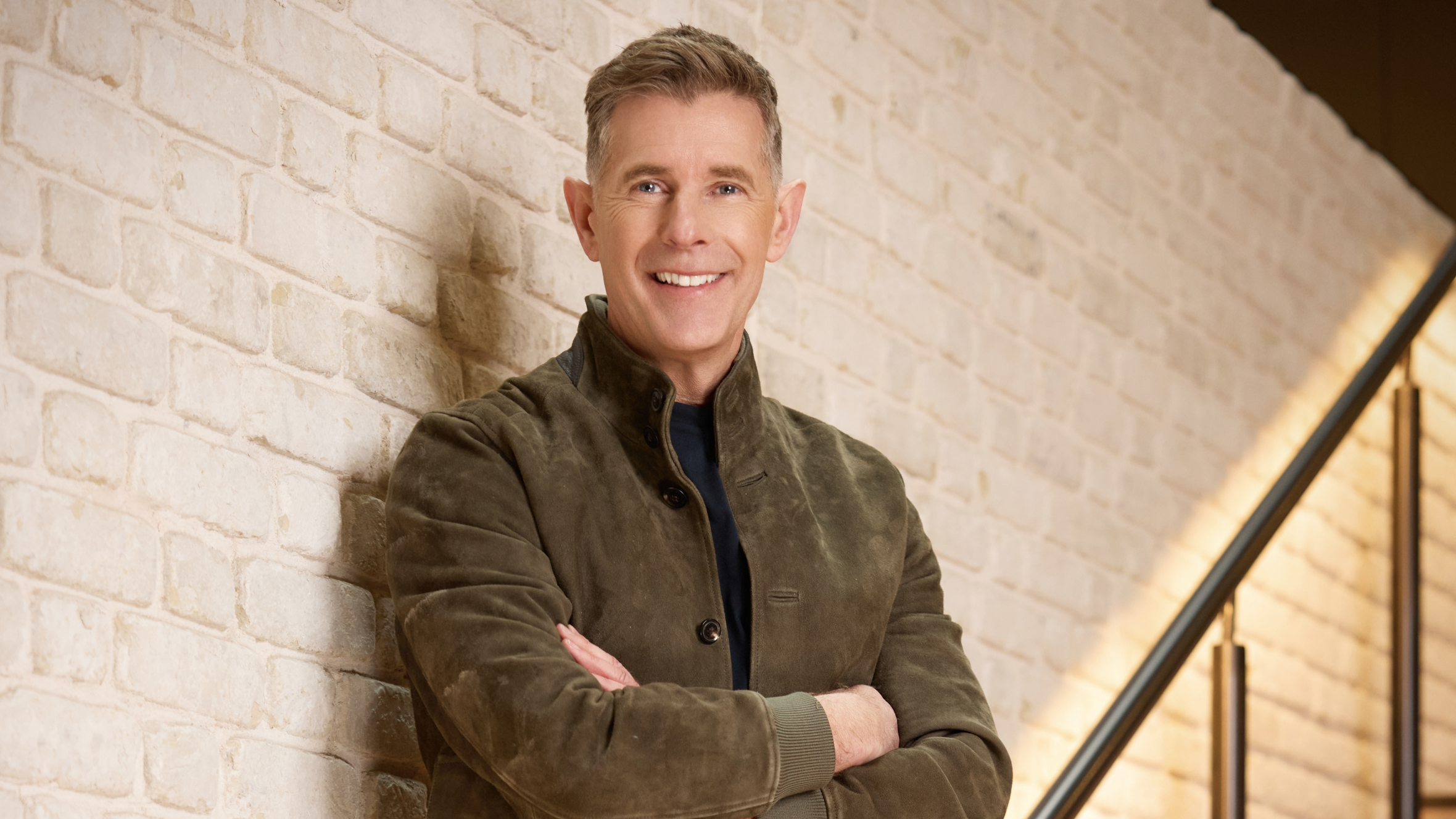
Room To Improve frontman Dermot Bannon talks to Marie television presenting, urban planning and getting his kids on the property ladder.
The publicity juggernaut that accompanies every new series of RTÉ 1’s ratings-winning show Room To Improve appears to be energising rather than exhausting frontman Dermot Bannon. This month 11 years ago, I first interviewed Bannon at the modest 1920s semi-D in Drumcondra where he then lived, but this morning, he arrives on our 10am Zoom call from his Clontarf office looking fitter and fresher, and more polished, than he did in 2015. The past decade has been good to Bannon.
The 52-year-old has continued to enjoy enormous success with Room To Improve and he is now the second longest-serving host of an Irish television show after Gay Byrne. “Seventeen seasons in and we’re still getting phenomenal ratings at the weekends. Thirteen percent of viewers, which is unreal,” he reveals excitedly. The success of the show has elevated Bannon from jobbing architect to commentator, speaker, author and occasional columnist and although he confesses that the volume of interviews he faces when the series airs can be tiring, he feels “privileged that people still want to talk to me.”
Since we first spoke, Bannon has also built his dream home, complete with a much-publicised outdoor sauna and cold-water shower. In 2020, he moved his family out of their characterful but cramped semi-D into a spectacular extended and modernised 1930s house on Griffith Avenue, which he designed and documented for a special two-part episode of Room To Improve, subtitled Dermot’s Home, giving viewers a rare behind-the-keyhole look into Bannon’s private life, which he refuses to compromise despite being one of the most recognisable and approachable faces in the country.
His wife of 24 years Louise stays firmly out of Bannon’s spotlight and didn’t appear in the series but works alongside him at the award-winning Dermot Bannon Architects. They have three children together and Bannon is the picture of a proud Dad when he speaks about them. His eldest, Sarah (21), who he held in his arms last time we met and told me how she wanted to be an Olympic gymnast, is now enjoying her Erasmus year in Sydney as part of her Marketing Innovation and Design degree at TU Dublin. James (17) is in fifth year and Bannon’s youngest, Tom (13), has settled happily into his first year of secondary school.
Being the father of young adults rather than young children has brought the country’s long-standing housing crisis into even sharper focus for the Malahide-born architect and he sighs as he reflects on their chances of getting onto the property ladder. “I’m fearful for my own kids, yes,” he says. “How will they ever be able to afford a home?” he asks. “I’m not an economist,” he adds, “but I don’t understand how a country with one of the highest GDPs in Europe, one of the lowest populations and one of the lowest densities can’t house everybody, and house everybody really well,” he says.
“This is not just a crisis in housing numbers but a crisis in how we’re building and the hollowing out of our city centres. For us to change and create a great city, it’s going to take 20 years. It’s not going to happen in three years. But unfortunately government cycles are four years and sometimes two years if parties swap over halfway through. Making our cities denser and better places to live is key,” he adds.
Bannon discovered the joy and convenience of city living in his 20s while studying at Hull School of Architecture in the north-east of England. “When I moved there, I was able to cycle everywhere, even to and from nightclubs, which I probably shouldn’t have,” he laughs. And I thought, ‘Oh my God, this is great’! He loves his Drumcondra home – the third property he’s bought in this part of Dublin – for the same reason. “I love living near the city; I can walk into Grafton Street in 30 minutes. I’m also a 20-minute walk from the seafront in Clontarf. We have the mountains on our doorstep. Dublin as a city is a fantastic place.” But he admits that when he hits O’Connell Street, he continues walking. “What’s on O’Connell Street?” he asks. “Nothing. I keep walking over the bridge to where it’s a nicer place to be. O’Connell Street needs to be sorted.”
This is not just a crisis in housing numbers but a crisis in how we’re building and the hollowing out of our city centres. For us to change and create a great city, it’s going to take 20 years.
Bannon is a passionate advocate of the ‘15-minute city’ (an urban planning concept where residents can access daily necessities within a 15-minute walk or bike ride from their home). “I think in Ireland we’ve become obsessed with back gardens and front gardens. I think a lot of people would much rather live in an apartment with good storage and a nice balcony, but in the city centre, where their office is just 15 minutes away and their walk to work is really enjoyable. You can pick up a coffee and chat with people. On the way home, you might go to the fish shop or the butchers and have another chat. That, for me, is life.”
Look at cities like Sydney, Paris and Copenhagen, he suggests. “We have an even better opportunity in this country because of our population size and density. But nobody seems to care. It looks to me like every time there’s a conversation about building housing, it’s just about delivering numbers.” He believes if his children and others want a home – and a home in the city – everybody needs to compromise. “We will have to have denser cities. We just can’t object to apartment developments in the city centre or say no to a metro because we don’t like the look of it from our back gardens.”
Having a platform to discuss topics like urbanism and Dublin’s regeneration is something Bannon is grateful to his television career for. “Room To Improve has its format so I can only talk about so much on the show, but chatting to publications or appearing on radio shows means I can keep the conversation going and veer off into broader issues. The show has given me a voice,” he says.
Room To Improve may have its parameters but over its 17-year-run it’s provided a fascinating chronicle of design trends in Ireland through boom, bust and pandemic. “When the show started in 2008, people weren’t in a position to move, so the brief was to create more space with extensions of one kind or another.” By the mid 2010s, the focus was on complete renovations of ‘fixer uppers’, he explains, and during Covid, “People were at home a lot more so it became about how a house functioned: utility rooms, good storage, multi-purpose spaces.” For the current series, “The dial has shifted towards energy upgrades,” Bannon says.
Despite the always-on juggle of family life, private practice and a TV career, Bannon reveals there’s still plenty still on his to-do list. The pulmonary embolism he suffered while on holiday in Portugal last year hasn’t put the brakes on his ambition. “There’s a lot of important conversations about housing and planning happening within architectural circles and on the periphery,” he explains, mentioning the Irish Cities in Crisis podcast hosted by Matt Cooper.
For the next 10 years, I’d like to look at what I can do to help; I think I can be the person who brings these conversations into the mainstream,” he says. “There’s loads of clever, talented people working away in the background. It’s just to get the ear and that’s where I come in.” This is likely to be Bannon’s most challenging project to date, but if he can get the attention of decision-makers and effect real change, it will be the most exciting transformation of his career.
Originally published in The Sunday Times Ireland, January 2026