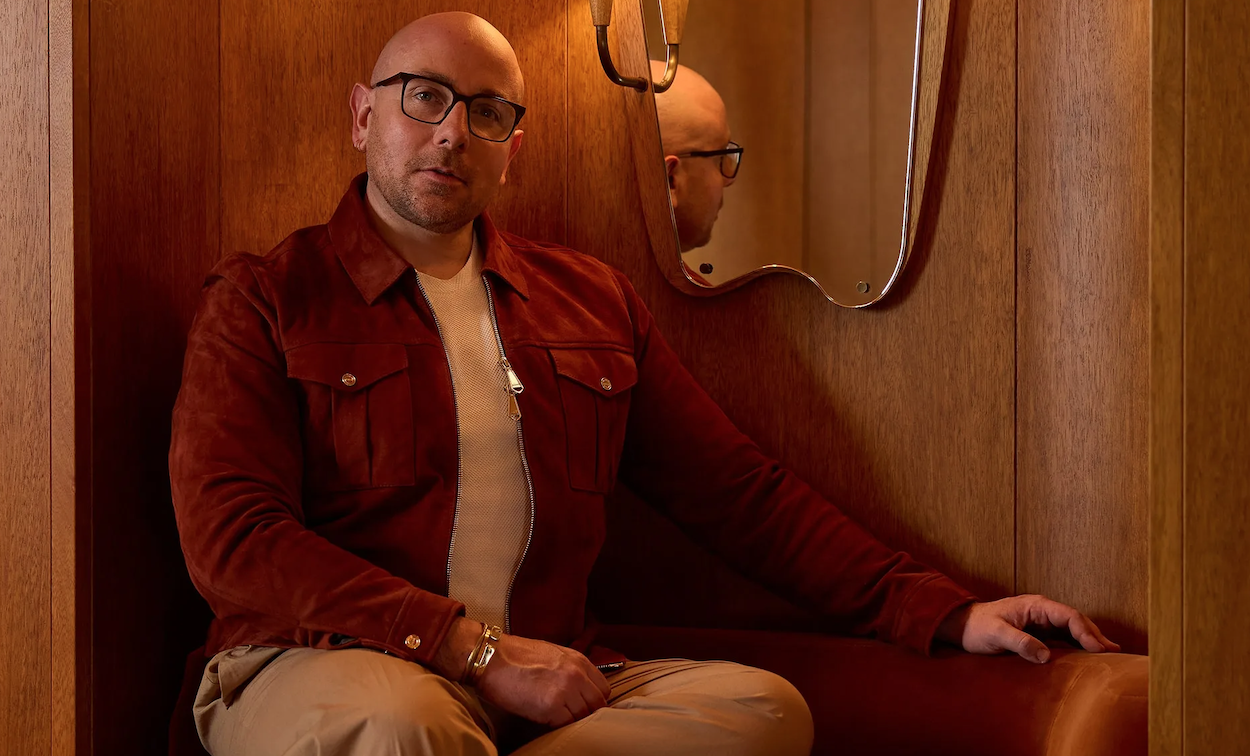
Celebrated interior designer Shayne Brady – the creative vision behind some of the UK’s most prestigious restaurants – begins a new chapter with the launch of his first solo practice. Marie Kelly meets the Kildare man-turned-toast-of-London.
When renowned interior designer Shayne Brady moved to London 18 years ago, he remembers standing outside the historic five-star Savoy hotel on The Strand. “I was too scared to go inside because, for me, it was so intimidating,” he says. Growing up in 1980s rural Co Kildare, he and his two brothers weren’t brought to fancy restaurants and hotels, he explains. “My parents didn’t have loads of money so I wasn’t exposed to that kind of lifestyle,” he adds. Now, almost two decades later, Brady is the creative visionary behind two rooms within the hotel: the café Scoff and Gallery restaurant. “It’s a full-circle, pinch-me moment,” he admits.
Earlier this year, the 42-year-old launched Studio Shayne Brady, his first solo interior design and interior architecture practice. It comes on the back of 12 hugely successful years with Brady Williams, the practice he established at 29 in the front living room of an Irish friend’s Victorian flat in south-east London with former colleague Emily Williams. “Emily and I had always said the partnership might not be forever – we weren’t getting married,” he laughs.
Brady describes this next phase as his “second chapter” and admits it’s been a little daunting “driving the cart solo” for the first time. “When Brady Williams was set up, I was 29 and naive. At 42, I have 12 years of worry behind me and it makes you that little bit more scared,” he says. “But Christian Dior set up Dior at 42,” he states. “I always come back to that.”
The flip side of the fear is the freedom Brady feels to pick and choose projects and decide exactly which direction he wants to take his brand. His focus has always been on the hospitality space and alongside the Savoy, projects include Harrods Champagne Terrace, Richard Corrigan’s rooftop restaurant at The National Portrait Gallery in London and The Maine restaurant in Mayfair. His portfolio boasts some of London’s most prestigious addresses and his client list is a who’s who of renowned restaurateurs and hoteliers. “When the right client comes along, I would love to do one or two residential projects, but it’s got to be a client who has the personality and gusto to do something a bit more escapist and transformative,” he explains.
Escapist is an apt description of Brady’s hotel and restaurant work. He creates spaces that are immersive and dramatic, theatrical even. He attributes this to an early interest in set design sparked by a trip to see a production of Les Misérables at what was then the Point Theatre when he was 15. “One of my older brothers took me to see it and it blew my mind,” says Brady. “It really opened up the idea of transformative design,” he adds. “I came home and painted a 2m x 2m Les Mis mural on the wall by my bed – it’s still there; my mother repainted the room but left the mural. I slept under it last week when I was visiting.”
Escapist is an apt description of Brady’s hotel and restaurant work. He creates spaces that are immersive and dramatic, theatrical even.
Like most eighties kids in Ireland, Brady admits his perception of interior design was shaped by the BBC DIY television show Changing Rooms. Nonetheless, he went on to study interior architecture at DIT (now TU Dublin) on Mountjoy Square then worked for Oppermann Associates before serendipitously moving to London in 2007, just before the financial crash. He admits it was brilliant timing. “I got out a year before everything crumbled.” He secured a job at RPW Design, a practice that focused on 250-300-bedroom hotels around the world, and he explains: “I think that’s when I recognized that public spaces in hotels could be really exciting, glamorous and escapist.” During his tenure there he also figured out that “It’s all well and good to have a great idea, but if you can’t get it built, you’re not a designer. Those were the years when I really figured out how to get a project built.”
Brady has a natural enthusiasm and curiosity. He’s clearly a people-person as he shows as much interest in me as I do in him. He values relationships – he remains good friends with his former business partner – and he namechecks several individuals who’ve played an important role in his life, including the late Irishman David Collins, a central figure in luxury interior design in London for four decades.
“David had great taste – impeccable taste – and a great way with colour and texture. He’s been a huge influence on me because he opened my eyes to two things: firstly, he showed me what great taste is, and secondly, he kicked to the curb any sense of imposter syndrome I had. Working for him, I watched him command the room, so to speak. I saw him coming from Ireland and having a studio in London where he was creating incredible work for the likes of Claridge’s and The Park. I thought if he can do it, why can’t I do it? He showed me that it’s possible to follow your dreams.”
While working for David Collins Studio, Brady met Jeremy King, Britain’s most revered restaurateur and the brains behind the original celebrity restaurant haunt, The Ivy. He became another pivotal person in Brady’s life and remains an “incredible friend”. “Towards the end of Brady Williams’ first year, Jeremy called and said, ‘I want you to do my next restaurant’. That was a pivotal moment and the following 10 months were also pivotal because I needed to prove I could do it alone without the infrastructure of a big company.” The relationship with King gave Brady Williams gravitas,” he says. “Other clients thought, well, if you’re good enough for Jeremy King, you’re at least worth talking to. That got us in the door. Then it was up to us to prove why we should sit at the table.”
Brady is not afraid to say that he’s “super ambitious”. “I think us Irish people don’t like to say things like that. But I am, and yes, ambition brings pressure and stress, but I am passionate about design and so ambition opens up more possibilities of designing great places and working with incredible collaborators and artists to create something special,” he says. He believes strongly that “what’s for you won’t pass you”. “I live by that mantra, so if we pitch for a project and don’t win it, then it’s not for us. And that’s fine.”
Brady’s ambition stretches beyond the UK; he’s in the early stages of setting up a satellite office in Miami. “We’re finalising a project there so it will be a joy to get the office sorted in the next 12-18 months.” Miami appeals to Brady more than the traditional design mecca of New York because it’s not “London on steroids”. “It offers me an alternative lifestyle and there’s so much happening in hospitality in Miami,” Brady explains. “South Beach and all of the art deco properties are completely up my avenue because I’m obsessed with history and heritage. And I would prefer the East Coast to the West Coast because of the time difference with London. There’s a lot of pulls toward Miami.”
This tropical metropolis is light years away from Brady’s childhood in the village of Two Mile House. His mother, who he says “looks at what I’ve achieved with immense pride and awe”, often wonders how the boy who spent his youth playing in fields is now designing swanky restaurants in one of the world’s fashion capitals. “In the eighties, parents’ mentality was ‘get out into the field and play’ and because I wasn’t into sports that much, or at all actually, it was about imagination. I used to just play in imaginary worlds.”
Brady describes his projects as “the sets for people’s everyday lives”. Each space tells a story. “A lot of the buildings we work with have a heritage and a previous life. I really think that to create something beautiful, you have to look to the past and respect what the past has done. For these spaces, I need a narrative and a story because otherwise we’re just painting a room really nicely and that’s not good enough for me. I need to go deeper. Sometimes I say to my team, it doesn’t matter if the public doesn’t ever know the narrative. Sometimes they will, sometimes they won’t. But what the narrative gives us is a backbone to rely on when we make decisions. Is the decision right based on our narrative and our journey? It comes back to this notion of creating worlds. A set designer would always be rooted in a story, a play, a piece of writing and there’d be characters and scenes. That’s what I like to do.”
The world he’s created for himself in London suits the self-confessed extrovert very well he says. He cycles everywhere and he recently bought a 1960s flat in Waterloo beside the Old Vic Theatre, which he’s hoping to renovate early this year [2026] with a sixties modernist aesthetic. He enjoys going to the theater once a week. “For me, plays and musicals are my time out. “They do inspire me work-wise, but really they are my time away from my phone, from work, from everything.”
Despite the glamour of London’s West End and the art deco hotels of South Beach, Brady’s happy place is the unassuming Hogan’s bar on South Great George’s Street. “Do you know that Hogan’s is the best pub in the world?” he asks me. “To sit in Hogan’s and have a pint or a gin and tonic on a Friday night is the best.”
This article was originally published in The Sunday Times Ireland, January 2026