Inside an artist’s historic home
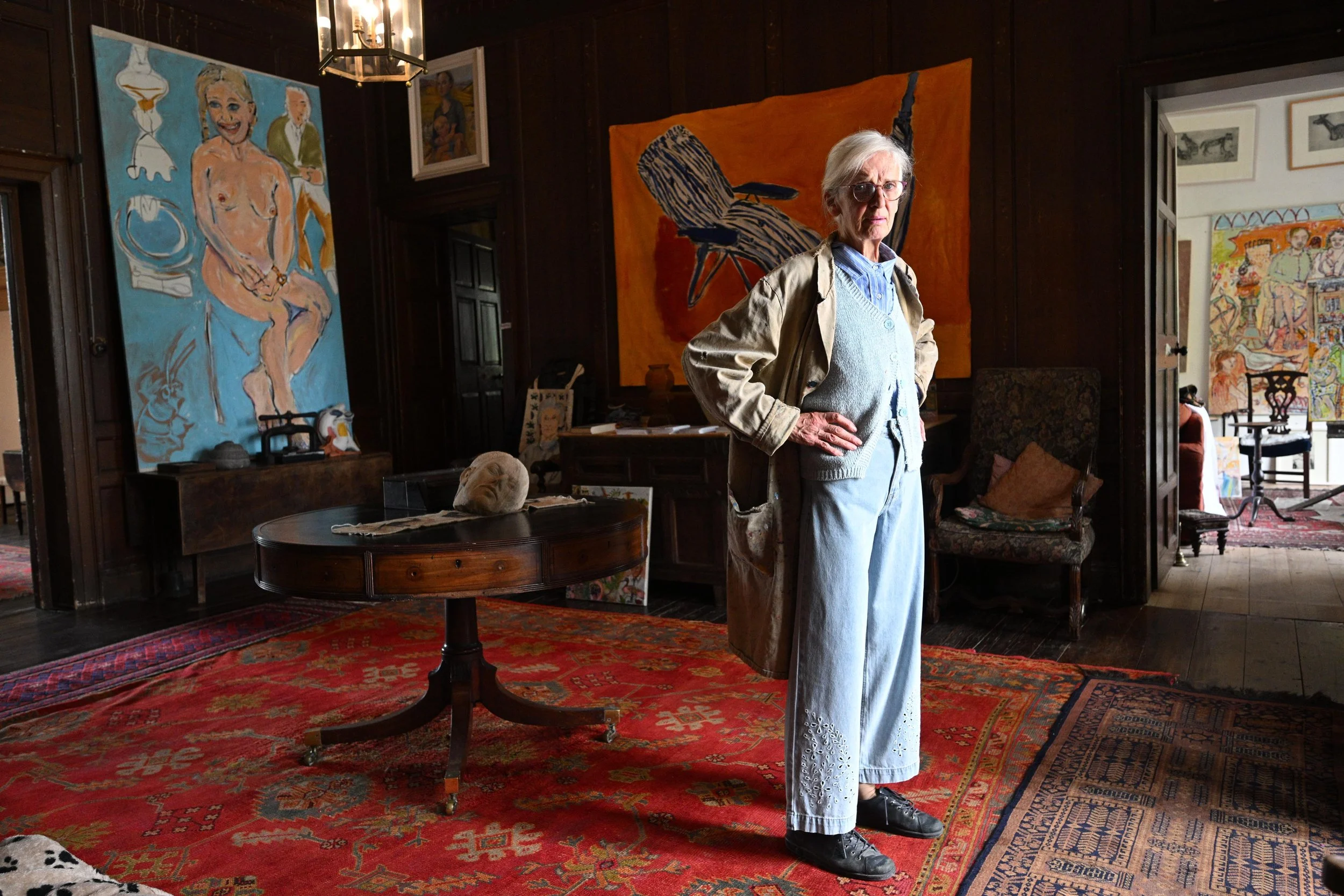
Artist Elizabeth Cope and her husband Geoffrey have created a home steeped in memories and reminders of its remarkable past, discovers Marie Kelly.
“A house has its own character,” says Elizabeth Cope. “You have to let a house live and breathe as it was meant to.” Since the artist and her historian husband, Geoffrey Cope, bought Shankill Castle at an auction in Kilkenny in 1990, the couple has allowed the house to age as naturally as they have, and 36 years on, Shankill Castle remains a richly layered home, steeped in memories and reminders of its remarkable past.
An intriguing patchwork of architectural styles, Shankill Castle has evolved over centuries rather than according to any grand architectural plan. Its Victorian façade suggests a 19th-century country house, but its origins stretch back to a 12th-century church. “Shankill means Old Church,” explains Elizabeth. “The Butlers built a tower house, which is the oldest part of the property, and when Peter Aylward bought it in 1708, he rebuilt it, he added the elegant long, narrow windows and tall doors. The drawing room was added in 1828 and the service wing in 1850.”
The Castle – or house as Elizabeth prefers to call it – retains its traditional upstairs-downstairs plan, with the entrance hall, dining room, ante room and drawing room on the ground floor, and a network of utilitarian service spaces below. In more than three decades, Elizabeth and her husband have made remarkably few alterations. “Beneath the dining room, we took down a brick wall between the coal cellar and what had been the servants’ hall to create a winter kitchen with an Aga,” she explains. “Opposite, under the front hall, were two further rooms – a wine cellar and the remains of a 17th-century kitchen. Again, we simply removed a brick wall between them and replaced an existing window with a door. The architect thought it was a good idea because we didn’t destroy anything; we simply brought light into the basement.”
Elizabeth and her husband have always inhabited every corner of the Castle and raised their three children within its storied walls, with no room ever cordoned off or reserved for special occasions. As a painter and a collector respectively, the house affords them both the space to pursue their passions. “My studio is wherever I am in the house,” Elizabeth says. “I can paint in the kitchen, I can paint in the lavatory, I can paint outside in the garden with people watching me,” she explains, “it really doesn’t bother me.” In fact, she loves the smell of oil paints and credits it with setting her on the path to becoming a painter. “My oldest sister Phil came home from Paris after a year working as an au pair and brought a box of oil paints with her. I remember the smell…it seduced me into becoming a painter.”
Elizabeth’s energetic and colourful paintings, which range in scale from dramatic floor-to-ceiling canvases to domestic-sized pieces, adorn walls, alcoves, landings and quiet corners throughout the house. Alongside Geoffrey’s ever-growing collection, which spills into every room and even outbuildings, the Castle feels as richly curated as a museum, but with an eclectic and lived-in warmth that is entirely unpretentious. This is the Castle’s singular appeal and for decades it has attracted art and culture enthusiasts eager to hear its unique story told by the people who have made it their home, rather than by a hired tour guide.
Recently, a new generation of visitors has started to discover the property through artist and Ballymaloe-trained chef William Murray’s hugely popular Currabinny food truck, which operates from the Castle’s stableyard Farm Shop. From April to October when the Farm Shop is open, Elizabeth gives one guided tour of the Castle a day. Although she insists she has no favourite room, she concedes that “the drawing room is quite a nice room to sit in”. Geoffrey’s collectibles include an old chest of drawers saved from Russellstown Park in Co Carlow, which was demolished in the 1950s, and the Victorian kitchen is home to several other favourite items, among them a collection of copper saucepans and an original bread oven. “When we first moved into Shankill Castle, I’d light a fire in the old range and serve tea and scones,” Elizabeth explains.
Scattered among these precious treasures from the past is a selection of idiosyncratic objects, such as a pink plaster head by Elizabeth, a duck sculpture by her son Reuben and a bright blue sculpture of a Morph-like man, revealing her playful personality. She likes a bit of kitsch and believes every interior benefits from a touch of humour and a measure of chaos. “When I go into someone’s house and everything is neat and tidy, I feel like I want to throw an old washing machine into the middle of it,” admits Elizabeth. Her daughter Sybil once brought her home a rubber lobster at the height of the Big Mouth Bill Bass singing fish craze of the early 2000s and since then she has often featured lobsters in her paintings. “You have to have humour,” she says.
The grounds of Shankill Castle are as rich with interest as the house itself. An orange scrap metal bird sculpture by Elizabeth’s brother, Michael Lawler, perches within the ruins of old stone walls, while a tinsmith’s anvil from Donegal has a dramatic sculptural appeal. Beyond lie a Victorian walled garden, the ancient church and graveyard and secret fairy woods, which unfold like scenes from a childhood storybook. The Copes are currently recreating a traditional Irish farmhouse in one of their stable buildings, which will open to the public during Heritage Week later this month. “We’re conservationists,” says Elizabeth. “We love the idea of old things.” The kitchen will feature items of furniture acquired by Geoffrey over the years and a red wringer, which she bought in a Belfast charity shop.
Elizabeth describes finding Shankill Castle all those years ago as “a stroke of luck”. “I’ve been to many different countries, I’ve lived in small spaces and I lived in a hostel for two years, so I suppose if we hadn’t found this place, I would have done what I’ve always done – just go with the flow. But I think living here was a great idea.” It takes a rare partnership and a shared vision to take on a home like Shankill. “Geoffrey and I almost always have the same taste whenever we go to a gallery or museum,” she says. “It’s an incredible thing. Geoffrey has a real sense of feeling for painting and for atmosphere.”
Elizabeth’s plan is to model Shankill Castle on Kettle’s Yard in Cambridge in the UK. “I’d like people to come and spend the day here. They can read, enjoy the house, then visit the yard and look at all of the country furniture from vanished traditional cottages. Nowadays, we’re too ready to wipe away history.”
This article was originally published in The Sunday Times Ireland, August 2026